Showing posts with label dato. Show all posts

Saturday, November 07, 2015

The Deep Learning Gold Rush of 2015

In the last few decades, we have witnessed major technological innovations such as personal computers and the internet finally reach the mainstream. And with mobile devices and social networks on the rise, we're now more connected than ever. So what's next? When is it coming? And how will it change our lives? Today I'll tell you that the next big advance is well underway and it's being fueled by a recent technique in the field of Artificial Intelligence known as Deep Learning.


The California Gold Rush of 2015 is all about Deep Learning. 
It's everywhere, you just don't know how to look.


All of today's excitement in Artificial Intelligence and Machine Learning stems from ground-breaking results in speech and visual object recognition using Deep Learning[1]. These algorithms are being applied to all sorts of data, and the learned deep neural networks outperform traditional expert systems carefully designed by scientists and engineers. End-to-end learning of deep representations from raw data is now possible due to a handful of well-performing deep learning recipes (ConvNets, Dropout, ReLUs, LSTM, DQN, ImageNet). But if there's one final takeaway that we can extract from decades of machine learning research, is that for many problems going deep isn't a choice, it's often a requirement.

Most of the apps and services you're already using (AirBnB, Snapchat, Twitch.tv, Uber, Yelp, LinkedIn, etc) are quite data-hungry and before you know it, they're all going to go mega-deep. So whether you need to revitalize your data science team with deep learning or you're starting an AI-from-day-one operation, it's pretty clear that everybody is rushing to get some of this Silicon Valley Gold.

From Titans to Gold Miners: Your atypical Gold Rush

Like all great gold rushes, this movement is led by new faces, which are pouring into Silicon Valley like droves. But these aren't your typical unskilled immigrants willing to pick up a hammer, nor your fresh computer science grads with some app-writing skills. The key deep learning players of today (known as the Titans of Deep Learning) are computer science professors and researchers (seldom born in the USA) leaving their academic posts and bringing their students and ideas straight into Silicon Valley.

"Turn on, Tune in, Dropout" -- Timothy Leary

Recently, Google and Facebook announced that their operations are now being powered by Deep Learning [2,3]. And with most Deep Learning Titans representing the tech giants (Yann LeCun at Facebook Research, Geoffrey Hinton at Google, Andrew Ng at Baidu), Deep Learning is likely to become one of the most sought after tech skills. With Toyota to invest in $1 Billion in Robotics and Artificial Intelligence Research (November 6, 2015), the announcement of YC Research (October 7, 2015), and the new Google Brain Residency Program "Pre-doc" AI jobs (October 26, 2015), Silicon Valley just got a whole lot more interesting.

Silicon Valley re-defines itself, yet again 

To understand why it took so long for Deep Learning to take-off, let's take a brief look at the key technologies which defined Silicon Valley over the last 50 years.  The following timeline gives an overview of where Silicon Valley has been and where it's going.


1970s: Semiconductors 
The story of the digital-era starts with semiconductors. "Silicon" in "Silicon Valley" originally referred to the silicon chip or integrated circuit innovations as well as the location (close to Stanford) of much tech-related activity. The dominant firm from that time period was Fairchild Semiconductor International and it eventually gave rise to more recognizable companies like Intel. For a more detailed discussion of this birthing era, take a look at Steve Blank's Secret History of Silicon Valley[4].
Read more about Fairchild at TechCrunch's First Trillion-Dollar Startup 

1980s: Personal Computers
Initially computers were quite large and used solely by research labs, government, and big businesses. But it was the personal computer which turned computer programming from a hobby into a vital skill. You no longer needed to be an MIT student to program on one of these badboys. While both Microsoft and Apple were founded in 1975 and 1976, respectively, they persevered due to their pioneering work in graphical user interfaces. This was the birth of the modern user-friendly Operating System. IBM approached Microsoft in 1980, regarding its upcoming personal computer, and from then on Microsoft would be King for a very long time.
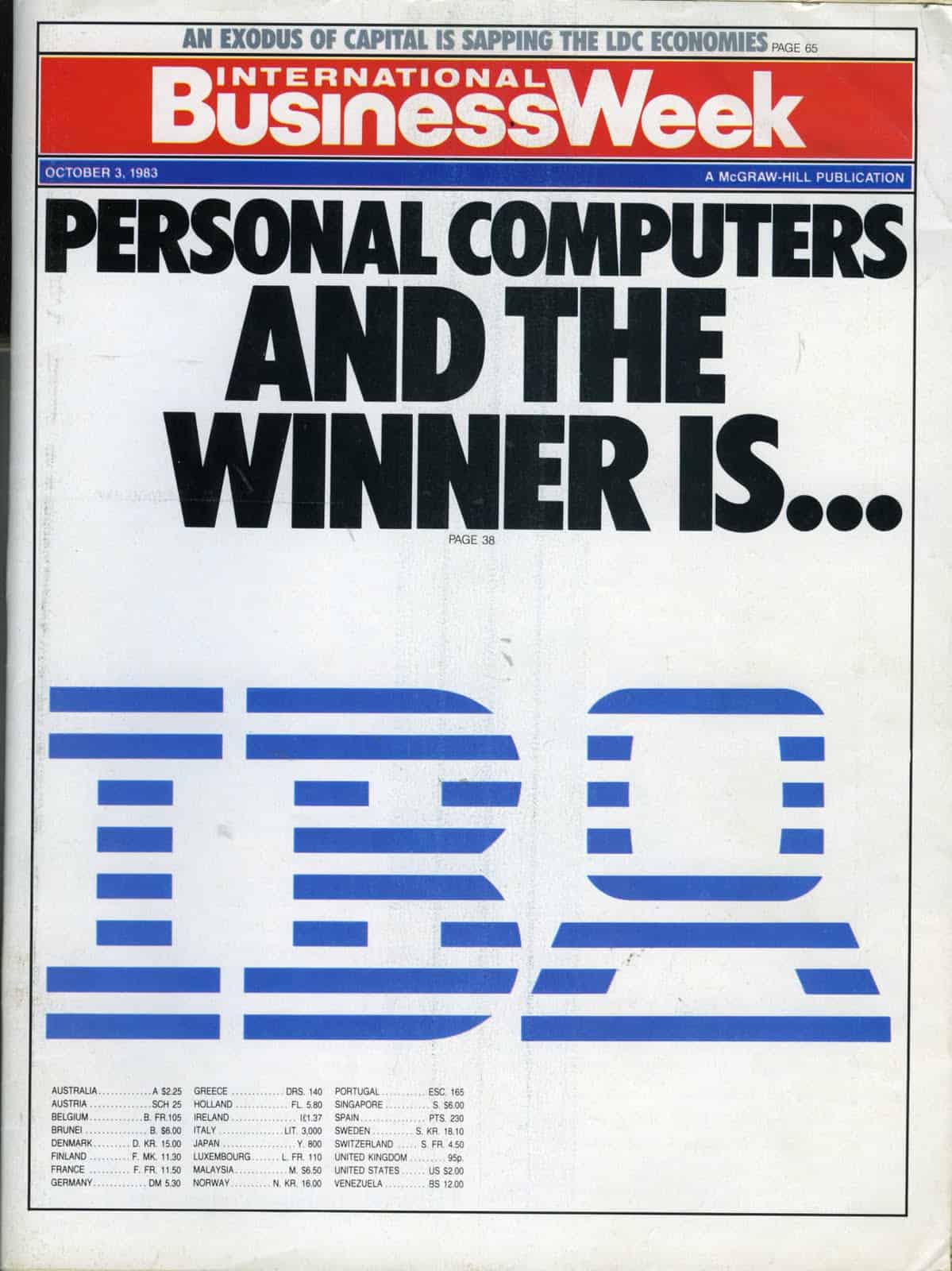
See Mac-history's article on Microsoft's relationship with Apple


1990s: Internet
While the nerds at Universities were posting ascii messages on newsgroups in the 90s, service providers in the 1990s like AOL helped make the internet accessible to everyone. Remember getting all those AOL disks in the mail? Buying a chunk of digital real state (your own domain name) became possible and anybody with a dial up connection and some primitive text/HTML skills could start posting online content. With a mission statement like "organize the world's information", it was eventually Google that got the most of out the late 90s dot-com bubble, and remains a very strong player in all things tech.

2000s: Mobile and Social
While the dot-com bubble was about creating an online presence for startups and established companies, the way we use the internet has dramatically changed since 2001. A ton of new social communities have emerged, and due to Facebook we're now stars in our own reality show. Social and advertising have essentially turned the modern internet into a mainstream TV-like experience. The internet is no longer only for the nerds. The kings of this era (Google and Facebook) are also the biggest players in the Deep Learning space, because they have the largest user bases and in-house apps which can benefit most from machine learning.

2010-2015: Deep Learning comes to the party
Spend more than a day in Silicon Valley and you'll hear the popular expression, "Software is eating the world." Rampant spreading of software was only possible once the internet (1990s) AND mobile devices (2000s) became essential parts of our lives. No longer do we physically mail floppy disks, and social media fuels any app that goes viral. What traditional software is missing (or has been missing up until now) is the ability to improve over time from everyday use. If that same software is able to connect to a large Deep Learning system and start improving, then we have a game-changer on our hands. This is already happening with online advertising, digital assistants like Siri, and smart auto-responders like Google's new email auto-reply feature.


The hierarchical award-winning "AlexNet" Deep Learning architecture 
Visualized using MIT's Toolbox for Deep Learning Neuron Visualization


Massive hiring of deep learning experts by the leading tech companies has only begun, but we also should be on the lookout for new ventures built on top of Deep Learning, not just a revitalization of last decade's successes. On this front, keep a close look at the following Deep Learning Cloud Service upstarts: Richard Socher from MetaMind, Matthew Zeiler from Clarifai, and Carlos Guestrin from Dato.

2015-2020: Deep Learning Revitalizes Robotics
Recently it has been shown that Deep Learning can be used to help robots learn tasks involving movement, object manipulation, and decision making[6,7,8,9]. Before Deep Learning, lots of different pieces of robotic software and hardware would have to be developed independently and then hacked together for demo day. Today, you can use one of a handful of "Deep Learning for Robotics recipes" and start watching your robot learn the task you care about.

Robots Learns to Grasp using Deep Learning at Carnegie Mellon University. 

With their 2013 acquisition of Boston Dynamics (a hardware play), 2014 acquisition of DeepMind (a software play), and a serious autonomous car play, Google is definitely early to the Robotics party. But the noteworthy bits are happening at the intersection of deep learning and robotics.  I suggest taking a closer look at the Robotics research of Pieter Abbeel of Berkeley, Abhinav Gupta of Carnegie Mellon, and Ashutosh Saxena of Stanford -- all likely stars in the next Deep Learning for Robotics race. As long as Rodney Brooks keeps creating innovative Robotics platforms like Baxter, my expectations for Robotics are off the charts.

Conclusion

Unlike in 1849, the Deep Learning Gold Rush of 2015 is not going to bring some 300,000 gold-seekers in boats to California's mainland. This isn't a bring-your-own-hammer kind of game -- the Titans have already descended from their Ivory Towers and handed us ample mining tools. But it won't hurt to gain some experience with traditional "shallow" machine learning techniques so you can appreciate the power of Deep Learning.

I hope you enjoyed today's read and have a better sense of how Silicon Valley is undergoing a transformation. And remember, today's wave of Deep Learning upstart CEOs have PhDs, but once Deep Learning software becomes more user-friendly (TensorFlow?), maybe you won't have to wait so long to dropout.


References

[1] Krizhevsky, A., Sutskever, I. and Hinton, G. E. ImageNet Classification with Deep Convolutional Neural Networks. In NIPS 2012.
[2] D'Onfro, J. Google is 're-thinking' all of its products to include machine learning. Business Insider. October 22, 2015.
[3] D'Onfro, J. How Facebook will use artificial intelligence to organize insane amounts of data into the perfect News Feed and a personal assistant with superpowers. Business Insider. November 3, 2015.
[4] Blank, S. Secret History of Silicon Valley. 2008.
[5] Donglai Wei, Bolei Zhou, Antonio Torralba William T. Freeman. mNeuron: A Matlab Plugin to Visualize Neurons from Deep Models. 2015.
[6] Lerrel Pinto, Abhinav Gupta. Supersizing Self-supervision: Learning to Graspfrom 50K Tries and 700 Robot Hours. arXiv. 2015.
[7] Sergey Levine, Chelsea Finn, Trevor Darrell, Pieter Abbeel. End-to-End Training of Deep Visuomotor Policies. In RSS 2015.
[8] Mnih, Volodymyr, et al. "Human-level control through deep reinforcement learning." Nature 518.7540 (2015): 529-533.
[9] Ian Lenz, Ross Knepper, and Ashutosh Saxena. DeepMPC: Learning Deep Latent Features for Model Predictive Control.  In Robotics Science and Systems (RSS), 2015


Wednesday, April 08, 2015

Deep Learning vs Probabilistic Graphical Models vs Logic

Today, let's take a look at three paradigms that have shaped the field of Artificial Intelligence in the last 50 years: Logic, Probabilistic Methods, and Deep Learning. The empirical, "data-driven", or big-data / deep-learning ideology triumphs today, but that wasn't always the case. Some of the earliest approaches to AI were based on Logic, and the transition from logic to data-driven methods has been heavily influenced by probabilistic thinking, something we will be investigating in this blog post.

Let's take a look back Logic and Probabilistic Graphical Models and make some predictions on where the field of AI and Machine Learning is likely to go in the near future. We will proceed in chronological order.

Image from Coursera's Probabilistic Graphical Models course

1. Logic and Algorithms (Common-sense "Thinking" Machines)


A lot of early work on Artificial Intelligence was concerned with Logic, Automated Theorem Proving, and manipulating symbols. It should not be a surprise that John McCarthy's seminal 1959 paper on AI had the title "Programs with common sense."

If we peek inside one of most popular AI textbooks, namely "Artificial Intelligence: A Modern Approach," we immediately notice that the beginning of the book is devoted to search, constraint satisfaction problems, first-order logic, and planning. The third edition's cover (pictured below) looks like a big chess board (because being good at chess used to be a sign of human intelligence), features a picture of Alan Turing (the father of computing theory) as well as a picture of Aristotle (one of the greatest classical philosophers which had quite a lot to say about intelligence).

The cover of AIMA, the canonical AI text for undergraduate CS students

Unfortunately, logic-based AI brushes the perception problem under the rug, and I've argued quite some time ago that understanding how perception works is really the key to unlocking the secrets of intelligence. Perception is one of those things which is easy for humans and immensely difficult for machines. (To read more see my 2011 blog post, Computer Vision is Artificial Intelligence). Logic is pure and traditional chess-playing bots are very algorithmic and search-y, but the real world is ugly, dirty, and ridden with uncertainty.

I think most contemporary AI researchers agree that Logic-based AI is dead. The kind of world where everything can be perfectly observed, a world with no measurement error, is not the world of robotics and big-data.  We live in the era of machine learning, and numerical techniques triumph over first-order logic.  As of 2015, I pity the fool who prefers Modus Ponens over Gradient Descent.

Logic is great for the classroom and I suspect that once enough perception problems become "essentially solved" that we will see a resurgence in Logic.  And while there will be plenty of open perception problems in the future, there will be scenarios where the community can stop worrying about perception and start revisiting these classical ideas. Perhaps in 2020.

Further reading: Logic and Artificial Intelligence from the Stanford Encyclopedia of Philosophy

2. Probability, Statistics, and Graphical Models ("Measuring" Machines)


Probabilistic methods in Artificial Intelligence came out of the need to deal with uncertainty. The middle part of the Artificial Intelligence a Modern Approach textbook is called "Uncertain Knowledge and Reasoning" and is a great introduction to these methods.  If you're picking up AIMA for the first time, I recommend you start with this section. And if you're a student starting out with AI, do yourself a favor and don't skimp on the math.

Intro to PDFs from Penn State's Probability Theory and Mathematical Statistics course

When most people think about probabilistic methods they think of counting.  In laymen's terms, it's fair to think of probabilistic methods as fancy counting methods.  Let's briefly take a look at what used to be the two competing methods for thinking probabilistically.

Frequentist methods are very empirical -- these methods are data-driven and make inferences purely from data.  Bayesian methods are more sophisticated and combine data-driven likelihoods with magical priors.  These priors often come from first principles or "intuitions" and the Bayesian approach is great for combining heuristics with data to make cleverer algorithms -- a nice mix of the rationalist and empiricist world views.

What is perhaps more exciting that then Frequentist vs. Bayesian flamewar is something known as Probabilistic Graphical Models.  This class of techniques comes from computer science, and even though Machine Learning is now a strong component of a CS and a Statistics degree, the true power of statistics only comes when it is married with computation.

Probabilistic Graphical Models are a marriage of Graph Theory with Probabilistic Methods and they were all the rage among Machine Learning researchers in the mid-2000s. Variational methods, Gibbs Sampling, and Belief Propagation were being pounded into the brains of CMU graduate students when I was in graduate school (2005-2011) and provided us with a superb mental framework for thinking about machine learning problems. I learned most of what I know about Graphical Models from Carlos Guestrin and Jonathan Huang. Carlos Guestrin is now the CEO of GraphLab, Inc (now known as Dato) which is a company that builds large-scale products for machine learning on graphs and Jonathan Huang is a senior research scientist at Google.

The video below is a high-level overview of GraphLab, but it serves a very nice overview of "graphical thinking" and how it fits into the modern data scientist's tool-belt. Carlos is an excellent lecturer and his presentation is less about the company's product and more about ways of thinking about next-generation machine learning systems.

A Computational Introduction to Probabilistic Graphical Models
by GraphLab, Inc CEO Prof. Carlos Guestrin (Video Link updated 4/17/2018)

If you think that deep learning is going to solve all of your machine learning problems, you should really take a look at the above video.  If you're building recommender systems, an analytics platform for healthcare data, designing a new trading algorithm, or building the next generation search engine, Graphical Models are the perfect place to start.

Further reading:
Belief Propagation Algorithm Wikipedia Page
An Introduction to Variational Methods for Graphical Models by Michael Jordan et al.
Michael Jordan's webpage (one of the titans of inference and graphical models)

3. Deep Learning and Machine Learning (Data-Driven Machines)

Machine Learning is about learning from examples and today's state-of-the-art recognition techniques require a lot of training data, a deep neural network, and patience. Deep Learning emphasizes the network architecture of today's most successful machine learning approaches.  These methods are based on "deep" multi-layer neural networks with many hidden layers. NOTE: I'd like to emphasize that using deep architectures (as of 2015) is not new.  Just check out the following "deep" architecture from 1998.

LeNet-5 Figure From Yann LeCun's seminal "Gradient-based learning
applied to document recognition" paper.

When you take a look at modern guide about LeNet, it comes with the following disclaimer:

"To run this example on a GPU, you need a good GPU. It needs at least 1GB of GPU RAM. More may be required if your monitor is connected to the GPU.

When the GPU is connected to the monitor, there is a limit of a few seconds for each GPU function call. This is needed as current GPUs can’t be used for the monitor while performing computations. Without this limit, the screen would freeze for too long and make it look as if the computer froze. This example hits this limit with medium-quality GPUs. When the GPU isn’t connected to a monitor, there is no time limit. You can lower the batch size to fix the timeout problem."

It really makes me wonder how Yann was able to get anything out of his deep model back in 1998. Perhaps it's not surprising that it took another decade for the rest of us to get the memo.

UPDATE: Yann pointed out (via a Facebook comment) that the ConvNet work dates back to 1989. "It had about 400K connections and took about 3 weeks to train on the USPS dataset (8000 training examples) on a SUN4 machine." -- LeCun


NOTE: At roughly the same time (~1998) two crazy guys in California were trying to cache the entire internet inside the computers in their garage (they started some funny-sounding company which starts with a G). I don't know how they did it, but I guess sometimes to win big you have to do things that don't scale. Eventually, the world will catch up.

Further reading:
Y. LeCun, L. Bottou, Y. Bengio, and P. Haffner. Gradient-based learning applied to document recognition. Proceedings of the IEEE, November 1998.

Y. LeCun, B. Boser, J. S. Denker, D. Henderson, R. E. Howard, W. Hubbard and L. D. Jackel: Backpropagation Applied to Handwritten Zip Code Recognition, Neural Computation, 1(4):541-551, Winter 1989

Deep Learning code: Modern LeNet implementation in Theano and docs.


Conclusion

I don't see traditional first-order logic making a comeback anytime soon. And while there is a lot of hype behind deep learning, distributed systems and "graphical thinking" is likely to make a much more profound impact on data science than heavily optimized CNNs. There is no reason why deep learning can't be combined with a GraphLab-style architecture, and some of the new exciting machine learning work in the next decade is likely to be a marriage of these two philosophies.


You can also check out a relevant post from last month:
Deep Learning vs Machine Learning vs Pattern Recognition

Discuss on Hacker News