Showing posts with label philosophy. Show all posts

Tuesday, July 10, 2012

Machine Learning Doesn't Matter?


Bagpipes and International Conference of Machine Learning (ICML) in Edinburgh
Two weeks ago, I attended the ICML 2012 Conference in Edinburgh, UK.  First of all, Edinburgh is a great place for a conference!  The scenery is marvelous, the weather is comfortable, and most notably, the sound of bagpipes adds an inimitable charm to the city.  I attended the conference because I was invited to give an invited applications talk during the invited talks session.  In case you’re wondering, I did not have a plenary session (a plenary session is a session attended by all conference members) which is preserved for titans such as Yann Lecun, David MacKay, and Andrew Ng.  My presentation was on the last day of ICML and was titled “Exemplar-SVMs for Visual Object Detection, Label Transfer and Image Retrieval,” during which I gave an overview of my ICCV 2011 paper on visual object detection as well as the SIGGRAPH ASIA 2011 paper on cross-domain image retrieval.  As part of the invited talk, we submitted a 2 page extended abstract which summarizes some key ideas behind the exemplar-svm project: you can check out the abstract as well as the presentation slides online.  I believe the talk was recorded, so I will post the video link once it becomes available.  It was a great opportunity to convey some of my ideas to a non-vision audience.  I think I got a handful of new people excited about single example SVMs (i.e., Exemplar-SVMs)!

Tomasz Malisiewicz, Abhinav Shrivastava, Abhinav Gupta, and Alexei A. Efros. Exemplar-SVMs for Visual Object Detection, Label Transfer and Image Retrieval. To be presented as an invited applications talk at ICML, 2012. PDF | Talk Slides


Getting Ready for Edinburgh with David Hume
To get ready for my first visit to Edinburgh (pronounced Ed-in-bur-ah which does not rhyme with Pittsburgh), I bought a Kindle Touch and proceeded to read David Hume’s An Enquiry Concerning Human Understanding.  David Hume is one of the great British Empiricists (together with John Locke and George Berkeley) who stood by the empiricist motto: impressions are the source of all ideas.  Empiricists can be contrasted to rationalists who appeal to reason as the source of knowledge.  [Of course, I am neither an empiricist nor a rationalist.  Such polarizing extremes are a thing of the past.  I am a pragmatists and my world-view combines elements from many different philosophies.]  I choose Hume’s treatise because he is the one whom Kant credits for awakening him from his dogmatic slumber.  I found Hume’s words rejuvenating, full of gedankenexperiments which show the limits of radical empiricism, and most notably is free on the Kindle store!  In your attempts to build intelligent machines, maybe you will also words of inspiration in the classics.  It was a great book to get into the Edinburgh mindset (although the ICML crowd is probably more familiar with a different University of Edinburgh figure, namely Reverend Bayes).

Impressions of ICML
I would first like to first say that the ICML website is well-organized and serves as a great tool during the conference!  Good job ICML!  There is a great mobile version of the ICML website which is excellent for visiting on your iPhone when figuring out which talk to go to next.  The ICML website also provides a forum for discussing papers and every paper gets a presentation and a poster.  The discussion boards do not seem heavily utilized but it would be great to use a moderator-style system to have the actual after-presentation questions come from this forum.  I’m sure something like this will actually arise in the upcoming years.  ICML is much smaller than CVPR (compare ~700 attendees with ~2000 attendees) which makes for a much more intimate environment.  I was amazed by the number of people proving bounds and doing “theoretical” non-applied machine learning.  Its like some people really don't care about anything other than analysis.  However, this is not my style, and I personally prefer to build “real” systems and combine insights from disparate disciplines such as mathematics, cognitive science, philosophy, physics, and computer science.  There is a bit of ICML and Machine Learning conferences which I think of as nothing more than mathturbation.  I understand there's merit to doing analysis of this sort -- somebody’s gotta do it, but if you’re gonna do it, please at least try to understand the implications of the real-world problem your dataset and task are trying to address.

Machine Learning doesn’t Matter?
The highlight of the conference by far was Kiri Wagstaff’s plenary talk “Machine Learning that Matters.”  Kiri gave an enchanting 30 minute presentation regarding what is rotten in the state of Edinburgh (aka what is wrong with the style of machine learning conferences).  Her words were gentle, yet harsh, while simultaneously enlightening, yet morbid.  She showed us, machine learning researchers, just how useless much of machine learning research is today.  Let’s not forget that Machine Learning is one of the most revolutionary ideas if the modern computer science classroom.  Trying to get a PhD in Computer Science and avoiding Machine Learning is like avoiding Calculus while getting and undergraduate degree in Engineering.  There is nothing wrong with machine learning as a discipline, but there is something wrong with researchers making the field overly academic.  Making a discipline overly academic means creating a self-contained, overly-mathematical, self-citing, and jargon-filled discipline which doesn’t care about world-impact but only cares to propagate a small community’s citation count.  Note that much of these arguments also apply to the CVPR world. But do not take my words for granted, read Kiri’s treatise yourself.  Abstract Below:


"Machine Learning that Matters" Abstract: Much of current machine learning (ML) research has lost its connection to problems of import to the larger world of science and society. From this perspective, there exist glaring limitations in the data sets we investigate, the metrics we employ for evaluation, and the degree to which results are communicated back to their originating domains. What changes are needed to how we conduct research to increase the impact that ML has? We present six Impact Challenges to explicitly focus the field’s energy and attention, and we discuss existing obstacles that must be addressed. We aim to inspire ongoing discussion and focus on ML that matters.

Kiri Wagstaff, "Machine Learning that Matters," ICML 2012.


If you have something to say in response to Kiri's treatise, check out her Machine Learning Impact Forum on http://mlimpact.com/.

Thursday, March 08, 2012

"I shot the cat with my proton gun."


I often listen to lectures and audiobooks when I drive more than 2 hours because I don't always have the privilege of enjoying a good conversation with a passenger.  Recently I was listening to some philosophy of science podcasts on my iPhone while driving from Boston to New York when the following sentence popped into my head:

"I shot the cat with my proton gun."


I had just listened to three separate Podcasts (one about Kant, one about Wittgenstein and one about Popper) when the sentence came to my mind.  What is so interesting about this sentence is that while it is effortless to grasp, it uses two different types of concepts in a single sentence, a "proton gun" and a "cat."  It is a perfectly normal sentence, and the above illustration describes the sentence fairly well (photo credits to http://afashionloaf.blogspot.com/2010/03/cat-nap-mares.html for the kitty, and http://www.colemanzone.com/ for the proton gun).

Cat == an "everyday" empirical concept
"Cat" is an everyday "empirical" concept, a concept with which most people have first hand experience (i.e., empirical knowledge).  It is commonly believed that such everyday concepts are acquired by children at a young age -- it is an exemple of a basic level concept which people like Immanuel Kant and Ludwig Wittgenstein discuss at great length.  We do not need a theory of cats for the idea of a cat to stick.


Proton Gun == a "scientific" theoretical concept
On the other extreme is the "proton gun." It is an example of a theoretical concept -- a type of concept which rests upon classroom (i.e., "scientific") knowledge.  The idea of a proton gun is akin to the idea of Pluto, an esophagus or cancer -- we do not directly observe such entities, we learn about them from books and by seeing illustrations such as the one below.  Such theoretical constructs are the the entities which Karl Popper and the Logical Positivists would often discuss.  


While many of us have never seen a proton (nor a proton gun), it is a perfectly valid concept to invoke in my sentence.  If you have a scientific background, then you have probably seen so many artistic renditions of protons (see Figure below) and spent so many endless nights studying for chemistry and physics exams, that the word proton conjures a mental image.  It is hard for me to thing of entities which trigger mental imagery as non-empirical.  

How do we learn such concepts?  The proton gun comes from scientific education!  The cat comes from experience!  But since the origins of the concept "proton" and the concept "cat" are so disjoint, our (human) mind/brain must be more-amazing-than-previously-thought because we have no problem mixing such concepts in a single clause.  It does not feel like these two different types of concepts are stored in different parts of the brain.

The idea which I would like you, the reader, to entertain over the next minute or so is the following:

Perhaps the line between ordinary "empirical" concepts and complex "theoretical" concepts is an imaginary boundary -- a boundary which has done more harm than good.  

One useful thing I learned from Philosophy of Science, is that it is worthwhile to doubt the existence of theoretical entities.  Not for iconoclastic ideals, but for the advancement of science!  Descartes' hyperbolic doubt is not dead.  Another useful thing to keep in mind is Wittgenstein's Philosophical Investigations and his account of the acquisition of knowledge.  Wittgenstein argued elegantly that "everyday" concepts are far from "easy-to-define." (see his family resemblances argument and the argument on defining a "game.")  Kant, with his transcendental aesthetic, has taught me to question a hardcore empiricist account of knowledge.

So then, as good cognitive scientists, researchers, and pioneers in artificial intelligence, we must also doubt the rigidity of those everyday concepts which appear to us so ordinary. If we want to build intelligent machines, then we must be ready to break down own understanding of reality, and not be afraid to questions things which appear unquestionable.

In conclusion, if you find popular culture reference more palatable than my philosophical pseudo-science mumbo-jumbo, then let me leave you with two inspirational quotes.  First, let's not forget Pink Floyd's lyrics which argued against the rigidity of formal education: "We don't need no education, We don't need no thought control." And the second, a misunderstood, yet witty aphorism which comes to us from Dr. Timothy Leary reminds us that there is a time for education and there is a time for reflection.  In his own words:  "Turn on, tune in, drop out."

Wednesday, September 28, 2011

Kant's Intuitions, the intentional stance, and reverse-engineering the mind


“Thoughts without content are empty, intuitions without concepts are blind. The understanding can intuit nothing, the senses can think nothing. Only through their unison can knowledge arise.” -- Immanuel Kant

“We live in a world that is subjectively open. And we are designed by evolution to be "informavores", epistemically hungry seekers of information, in an endless quest to improve our purchase on the world, the better to make decisions about our subjectively open future.” -- Daniel Dennett

"For scientists studying how humans cometo understand their world, the central challenge is this: How do our minds get so much from so little? We build rich causal models,make strong generalizations, and construct powerful abstractions, whereas the input data are sparse, noisy, and ambiguous—in every way far too limited. A massive mismatch looms between the information coming in through our senses and the outputs of cognition." -- Josh Tenenbaum

Organizing by space (space, time, and physics)
There are two faculties of understanding which it is unlikely we have acquired from experience.  The first is that of understanding objects as extended bodies in a 3D space and thus occupying some volume.  I believe it is Kant argued best against the hardcore British Empiricists, who proclaimed that experience is the sole originator of knowledge.  Experiences are the pen strokes, which fill the Empricisit’s tabula rasa.  Kant argued (against Hume) that the concept of a spatially extended object is not acquired from experience – the very notion of experience requires that we already possess the notion of an object in order to have a meaningful percept.  It is as if the Empiricists failed to acknowledge that to make strokes on a sheet of paper, we need to already have a pen.  Kant’s intuitions are the pens of experience.  The requirement of having suitable intuitions for grouping percepts into experiences is what Kant described as a form of transcendental idealism.  “Objectness” is a faculty of human understanding, not something acquired from experience.  If you are a vision researcher, being aware of this can have drastic implications on your research programme.

It has also been argued that there are some primitive notions of object dynamics, aka folk-physics, which can are possessed by very young children.  Given the uniformity of human experience (at least I have no ostensible reason to double that my colleague’s experiences significantly differ from my own), and the diversity in our individual upbringing, it is also unlikely that folk-physics is learned from experience.  However, I don't want to make any strong claims regarding folk-physics.  I feel safe to say that Quantum Mechanics is another story -- it requires years of mathematics and thousands hours of deliberate problem solving to grasp.

Organizing by mind (psychology, mind, and intent)
The second faculty of understanding, which can be found in many aspects of human intelligence, is that of understanding the world in terms of cognitive agents.  Humans have an amazing capability when it comes to attributing stuff with having a mind.  This way of thinking about the world is so common and uniform among children all over the world, that the differences in their upbringing cannot be reconciled with the uniformity of their capability to project humanness onto objects.  Consider the following video (thanks J. Tenenbaum's videos/lectures for pointing this out).


We cannot just view this video os triangles, dots, and lines.  Each one of understands the story in terms of a narrative based on agents and their intent.  We are stimulated by the external world, we take as input sense-data, and the brain helps us make sense of it -- it turns the hodgepodge of data into experience.  But the brain is a mold, it conforms percepts to some shape defined by the mold.  These molds are the faculties of understanding which let us understand things, it is like the faculties of understanding are basis vectors onto which we project all input sense data.  The data is weak and noisy, the priors are strong, and understanding is the result of their union.  An experience without a proper basis is blind, it is just a ball of percepts.  These faculties allow us to have experience.  The experiences, coupled with memory, allow us to obtain understanding – where understanding is the relationship between a given experience and past experiences, either in the form of direct associations between currently-experienced-objects and previously-experienced-objects, or rules abstracted away from previously-experienced-objects being directly applied to the current sense data.

What I am talking about is what philosopher Daniel Dennett refers to by the “intentional stance.”  Given my background in AI and philosophy of mind, it is very likely that Dennett and I have had the same influences.  I like to juxtapose my ideas with those of the classical philosophers such as Descartes, Locke, Kant, Wittgenstein and Pinker -- I’m not sure how Dennett motivates his philosophy nor do I know against whose ideas he juxtaposes his own stance.


At MIT, J. Tenenbaum is pushing these ideas to the next level.  I only wish there was more perception in his work -- toy worlds just don't do it for me.  I want to build intelligent machines, and really cannot afford to sidestep the issue of perception.  Here is a great talk by Josh Tenenbaum on reverse engineering the mind from NIPS 2010. Video is on videolectures.net, just click the link.


Implications for Artificial Intelligence and Machine Vision
Following Josh Tenenbaum, I think that a criticism of classical machine learning is long overdue.  Machine Learning, as a field, has been spewing out hardcore empiricists.  “Let me download your features, my machine learning algorithm will take care of the rest,” they say.  It is like the glory is in the mathematics, which manipulates N-D vectors.  But I argue that intelligence isn’t “in the calculus,” it is what the primitives in the calculus actually represent.  As an undergraduate I proclaimed, “I am not a mathematician, I am a physicists.  I care about the structure of the world, not the structure of proofs. “  As a graduate student I proclaimed, “The glory isn’t in the manipulation of vectors, the glory is understanding the what/why of encoding information about the world into vectors.  I am a computer vision researcher, not a machine learning researcher.”  That is why the view of the world as coming from K different classes is wrong – this is merely a convenient view if the statistician’s toolbox is at your disposal.  It is all about structuring the input to match a researcher’s high-level intuitions about the world. 

Thursday, March 24, 2011

Computer Vision is Artificial Intelligence

Computer vision is a diverse field and its researchers have multifaceted interests and aspirations.  It should not be surprising that no two vision researchers think about the field in the same way.  Different academic backgrounds foster alternative and potentially incommensurable interpretations.  It is as if W.V.O Quine's thesis that no observation can be "theory-independent" directly applies to vision: a researcher in computer vision cannot uphold a view on his own field that is objective and independent of their own predispositions, upbringing, and educational program.  While I cannot speak clearly about the long-term goals of the entire body researchers in vision, today I would like discuss my own take on computer vision.  I do not offer the world an objective account of why computer vision intrigues me, but by sharing with the world the reasons why I find vision exciting, perhaps together we can break the boundaries of machine intelligence.


Cognitive Science is a computational study of the mind: McGill Cognitive Science


One of the biggest accomplishments in the field of Artificial Intelligence was when Deep Blue, a chess playing program developed at IBM, beat the world chess champion, Garry Kasparov.  But this was in the early days of artificial intelligence -- when computer scientists still weren't sure on what it means for a machine to be intelligent.  Chess is a well-known thinking-man's game, and at first glance it seems that a machine can only be worthy of being dubbed intelligent if it performs competitively on intelligent-people activities such as chess.

Chess: Human vs. Machine: Slate article about Deep Blue


Given the plethora of tasks that humans can effortlessly perform in daily life, is engineering a machine to rival humans on just one such task bringing researchers any closer to building truly intelligent machines?

The problem with chess is that it has a "finite universe problem" -- there is a finite number of primitives (the chess pieces) which can be manipulated by choosing a move from a finite set of allowable actions.  But if we think of normal life (going to work, eating dinner, talking to a friend) as a game, then it is not hard to see that most everyday situations involving humans involve a sea of infinite objects (just look around and name all the different objects you can see around you!) and an equally capacious space of allowable actions (consider all the things you could with all those objects around you!).  Intelligence is what allows us to cope with the complexities of the universe by focusing our attention on a limited set of relevant variables -- but the working set of objects/concepts we must consider at any single instant is chosen from a seemingly infinite set of alternatives.

I believe that everyday human-level visual intelligence is greatly undervalued by people -- and there is a very good reason for this!  The ability to make sense of what is going on in a single picture is such a trivial and autonomous task for humans, that we don't even bother quantifying just how good we are at it.  But let me reassure you that automated image understanding is no trivial feat.  The world is not composed of 20 visual object categories and the space of allowable and interpretable utterances we could associate with a static picture is seemingly infinite.  While the 20 category object detection task (as popularized by the PASCAL VOC) does have a finite universe problem, the grander version of the vision master problem (a combination of detection/recognition/categorization where you can interpret an input any way you like) is much more complex and mirrors the structure of the external world well.


Robotics Challenge: Build a Robot like Bender


Any application which calls for automated analysis of images requires vision.  A robot, if it is to be successful interacting with the world and performing useful tasks, needs to perceive the external world and organize it.  While some see vision as just one small piece of the "Robotics Challenge" (build a robot and make it do cool stuff), it totally unclear to me where to draw the boundary between low-level pixel analysis and high-level cognitive scene understanding.  Over the years, I have been thinking more and more about this problem, and I've convinced myself that the interesting part of vision is precisely at the boundary between what is commonly thought of as low-level representation of signal and what is considered high-level representation of visual concepts.  While some view computer vision as "applied mathematics" or "applied machine learning" or "image processing in disguise", I passionately believe the following:

Computer Vision is Artificial Intelligence

I am not promulgating the thesis that all aspects of machine intelligence are visual, but I want to assure you that there are enough high-level semantic capabilities which must be set in place for vision to work, that it is not worthwhile to think of vision as smaller problem than general purpose intelligence.  I believe that once we have made progress on vision (not in the narrow-universe setting) to the point where generic visual scene understanding is effectively solved, there won't be much left that needs to go into the "ethereal" mind which cognitive scientists want to empower machines with!  The only way to make machines truly understand scenes, objects, and their interactions is to make machines know something about the fabric of human life, and it is important for machines to learn this for themselves from real-world experience.  This goes beyond representing object appearance because folk physics, folk psychology, causality, spatio-temporal continuity, etc are all faculties which vision systems will need (at least the vision systems I want to ultimately build) for general purpose scene understanding.  I don't want to undermine the efforts of cognitive scientists (which work on many of the theories/ideas I've delineated before), but perhaps only to convince them that I have been a cognitive scientist all along.  I don't think placing a label on myself, by calling myself as either a cognitive scientist, a computer vision researcher, or AI researcher is very conducive to good research.

Monday, November 22, 2010

I, for one, welcome our new Visual Memex-based overlords

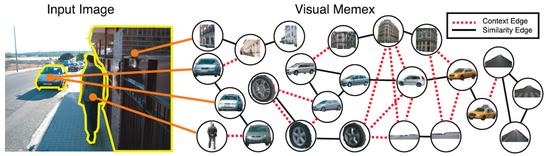
Welcome to the era of visual intelligence -- the era of Visual Memex-based overlords (now in 3D!)


The goal of today's post is simple: to empower you, the reader, with an exciting and fresh perspective on the problem of visual reasoning.  This simple idea is one of the central tenets promulgated in my upcoming doctoral dissertation -- and but I'd like to give this potent meme a head start.  Visual Memex-style reasoning is not the kind of reasoning that is described in classic graduate level textbooks on AI (e.g. first-order logic).  In the case that you've mentally over-fit to a graduate-level CS curriculum, you might even portray my iconoclastic views as ramblings of a lunatic -- this is okay, I know at least Ludwig would be proud.

The Visual Memex is a mentality/perspective which, I believe, can overcome many limitations faced by modern computer vision systems.  What the Visual Memex can do for visual intelligence is akin to what the World Wide Web has done for knowledge (see Weinberger's excellent book "Everything is Miscellaneous" for the full argument).  It's akin to using Google for acquiring knowledge instead of going to the library -- maybe knowledge was never meant to be embedded in bookshelves.  The idea is embarrassingly simple: replace visual object categories with object exemplars and relationships between those exemplars.  Maybe the linguistic categories that we (as humans) cannot seem to live without are mere shadows cast on the wall of a dark cave.  Psychologists have long abandoned rigid categories in their models of how humans think about concepts, but the notion of a class is so fundamental to contemporary Machine Learning that many haven't even bothered to question its tenuous foundations.  While categories (also referred to as classes) definitely make learning algorithms easier to formalize, maybe its better to let the data speak for itself.  Free the data!


One upcoming research paper inspired by this category-free mentality is: Context-Based Search for 3D Models, by Matthew Fisher and Pat Hanrahan, of Stanford University.  This paper will be presented at SIGGRAPH Asia 2010.  Maybe it is time to abandon those rigid categories and memexify your own research problem?

Further reading:


Thursday, March 18, 2010

Back to basics: Vision Science Transcends Mathematics

Vision (a.k.a. image understanding, image interpretation, perception, object recognition) is quite unlike some of the mathematical problems we were introduced to in our youth. In fact, thinking of vision as a "mathematical problem" in the traditional sense is questionable. An important characteristic of such "problems" is that by pointing them out we already have a notion of what it would be like to solve them. Does a child think of gravity as such a problem? Well, probably not, because without the necessary mathematical backbone there is no problem with gravity! It's just the way the world works! But once a child has been perverted by mathematics and introduced into the intellectual world of science, the world ceases to just be. The world become a massive equation.

Consider the seemingly elementary problem of finding the roots of a cubic polynomial. Many of us can recite the quadratic equation by heart, but not the one for cubics (try deriving the simpler quadratic formula by hand). If we were given one evening and a whole lot of blank paper, we could try tackling this problem (no Google allowed!). While the probability of failure is quite high (and arguably most of us would fail), it would still make sense of "coming closer to the solution". Maybe we could even solve the problem when some terms are missing, etc. The important thing here is that the notion of having reached a solution is well-defined. Also, once we've found the solution it would probably be easier to convince ourselves that it is correct (verification would be easier than actually coming up with the solution).

Vision is more like theoretical physics, psychology, and philosophy and less like the well-defined math problem I described above. When dealing with the math problem described above, we know what the symbols mean, we know valid operations -- the game is already set in place. In vision, just like physics, psychology and philosophy, the notion of a fundamental operational unit (which happens to be an object for vision) isn't rigidly defined as the Platonic Ideals used throughout mathematics. We know what a circle is, we know what a real-valued variable is, but what is a "car"? Consider your mental image of a car. Now remove a wheel and ask yourself, is this still a car? Surely! But what happens as we start removing more and more elements. At what point does this object cease to be a car and become a motor, a single tire, or a piece of metal? The circle, a Platonic Ideal, ceases to become a circle once it has suffered the most trivial of all perturbations -- any deviation from perfection, and boom! the circle ceases to be a circle.

Much of Computer Vision does not ask such metaphysical questions, as objects of the real world are seamlessly mapped to abstract symbols that our mathematically-inclined PhD students love to play with. I am sad to report that this naive mapping between objects of the real world and mathematical symbols isn't so much a questions of style, it is basically the foundation of modern computer vision research. So what must be done to expand this parochial field of Vision into a mature field? Wake up and stop coding! I think Vision needs a sort of a mental coup d'état, a fresh outlook on old problem. Sometimes to make progress we have start with a clean slate -- current visionaries do not possess the right tools for this challenging enterprise. Instead of throwing higher-level mathematics at the problem, maybe we are barking up the wrong tree? However, if mathematics is the only thing we are good at, then how are we to have a mature discussion which transcends mathematics? The window through which we peer circumscribes the world we see.

I believe if we are to make progress in this challenging endeavor, we must first become Renaissance men, a sort of Neitzschean Übermensch. We must understand what has been said about perception, space, time, and the structure of the universe. We must become better historians. We must study not only more mathematics, but more physics, more psychology, read more Aristotle and Kant, build better robots, engineer stabler software, become better sculptors and painters, become more articulate orators, establish better personal relationships, etc. Once we've mastered more domains of reality, and only then, will we have a better set of tools for coping with paradoxes inherent in artificial intelligence. Because a better grasp on reality -- inching closer to enlightenment -- will result in asking more meaningful questions.

I am optimistic. But the enterprise which I've outlined will require a new type of individual, one worthy of the name Renaissance Man. We aren't interested in toy problems here, nor cute solutions. If we want to make progress, we must shape our lives and outlooks around this very fact. Two steps backwards and three steps forward. Rinse, lather, repeat.

Tuesday, January 26, 2010

Beyond Categories =? Doing without Concepts

The term "beyond category," from my limited knowledge, was originally coined to describe the music of Duke Ellington. It is a term of praise that acknowledges that one's style is inimitable and transcends barriers.

"Beyond Categories" was the first part of my NIPS 2009 paper's title. To "go beyond" means to transcend, to abandon or do without some limitation and strive higher -- there is nothing magical about my use of the term. I used the term category to refer to object categories, as are commonly used in computer vision, artificial intelligence, machine learning, as well as psychology, philosophy, and other branches of cognitive science. One of my research goals is to go beyond the use of categories as the basis for machine perception and visual reasoning. It has been argued by Machery that the term category is roughly equivalent to the term concept as used in psychology literature. In some sense the title of Machery's recent book, "Doing without concepts," is analogous to the phrase "Beyond categories" but to reassure myself I'll have to finish reading Machery's book.


So far the first chapter has been a delightful exposition into the world of concepts, a term dear to researchers in machine perception (AI) as well as human categorization (psychology). I look forward to reading the rest of the book, which I accidentally found while looking for Estes' book on categorization. I had already digested/assimilated some of Machery's work, in particular his paper titled Concepts are not a natural kind, so seeing his name on a book at the CMU library piqued my interest. In this 2005 paper, Machery argues that the debate between prototypes vs. exemplars vs. theories in the literature on concepts is not well-founded and there is no reason to believe a single theory should prevail. I'll attempt to summarize some of his take-home messages and their relevance to computer vision once I finish this book.

Monday, October 26, 2009

Wittgenstein's Critique of Abstract Concepts

In his Philosophical Investigations, Wittgenstein argues against abstraction -- via several thought experiments he strives to annihilate the view that during their lives humans develop neat and consistent concepts in their minds (akin to building a dictionary). He criticizes the commonplace notions of meaning and concept formation (as were commonly used in philosophical circles at the time) and has contributed greatly to my own ideas regarding categorization in computer vision.

Wittgenstein asks the reader to come up with the definition of the concept "game." While we can look up the definition of "game" in a dictionary, we can't help but feel that any definition will be either too narrow or too broad. The number of exceptions we would need in a single definition scales as the number of unique games we've been exposed to. His point wasn't that game cannot be defined -- it was that the lack of a formal definition does not prevent us from using the word "game" correctly. Think of a child growing up and being exposed to multi-player games, single-player games, fun games, competitive games, games that are primarily characterized by their display of athleticism (aka sports or Olympic Games). Let's not forget activities such as courting and the Stock Market which are also referred to as "games." Wittgenstein criticizes the idea that during our lives we somehow determine what is common between all of those examples of games and form an abstract concept of game which determines how we categorize novel activities. For Wittgenstein, our concept of game is not much more than our exposure to activities labeled as games and our ability to re-apply the word game in future context.

Wittgenstein's ideas are an antithesis to Platonic Realism and Aristotle's Classical notion of Categories, where concepts/categories are pure, well-defined, and possess neatly defined boundaries. For Wittgenstein, experience is the anchor which allows us to measure the similarity between a novel activity and past activities referred to as games. Maybe the ineffability of experience isn't because internal concepts are inaccessible to introspection, maybe there is simply no internal library of concepts in the first place.

An experience-based view of concepts (or as my advisor would say, a data-driven theory of concepts) suggests that there is no surrogate for living a life rich with experience. While this has implications for how one should live their own life, it also has implications in the field of artificial intelligence. The modern enterprise of "internet vision" where images are labeled with categories and fed into a classifier has to be questioned. While I have criticized categories, there are also problems with a purely data-driven large-database-based approach. It seems that a good place to start is by pruning away redundant bits of information; however, judging what is redundant and how is still an open question.

Friday, July 03, 2009

Linguistic Idealism

I have been an anti-realist since a freshman in college. Due to my lack of philosophical vocabulary I might have even called myself an idealist back then. However, looking back I think it would have been much better to use the word 'anti-realist.' I was mainly opposed to the correspondence theory of truth which presupposes an external, observer independent, reality to which our thoughts and notions are supposed to adhere to. It was in the context of the Philosophy of Science that I acquired my strong anti-realist views, (developing my views while taking Quantum Mechanics, Epistemology, and Artificial Intelligence courses at the same time). Pragmatism -- the offspring of William James -- was the single best view which best summarized my philosophical views. While pragmatism is a rejection of the absolutes, an abandonment of metaphysics, it does not get in the way of making progress in science. It is merely a new a perspective on science, a view that does not undermine the creativity of the creator of scientific theories, a re-rendering of the scientist as more of an artist and less of a machine.

However, pragmatism is not the anything-goes postmodern philosophy that many believe it to be. It is as if there is something about the world which compels scientists to do science in a similar way and for ideas to converge. I recently came across the concept of Linguistic Idealism, and being a recent reader of Wittgenstein this is a truly novel concept for me. Linguistic Idealism is a sort of dependence on language, or the Gamest-of-all-games that we (humans) play. It is a sort of epiphany that all statements we make about the world are statements within the customs of language which results in a criticism of the validity of those statements with respect to correspondence to an external reality. The criticism of statements' validity stems from the fact that they rely on language, a somewhat arbitrary set of customs and rules which we follow when we communicate. Philosophers such as Sellars have gone as far as to say that all awareness is linguistically mediated. If we step back, can we say anything at all about perception?

I'm currently reading a book on Wittgenstein called "Wittgenstein's Copernican Revolution: The Question of Linguistic Idealism."

Tuesday, June 16, 2009

On Edelman's "On what it means to see"

I previously mentioned Shimon Edelman in my blog and why his ideas are important for the advancement of computer vision. Today I want to post a review of a powerful and potentially influential 2009 piece written by Edelman.

Below is a review of the June 16th, 2009 version of this paper:
Shimon Edelman, On what it means to see, and what we can do about it, in Object Categorization: Computer and Human Vision Perspectives, S. Dickinson, A. Leonardis, B. Schiele, and M. J. Tarr, eds. (Cambridge University Press, 2009, in press). Penultimate draft.

I will refer to the article as OWMS (On What it Means to See).

The goal of Edelman's article is to demonstrate the limitations of conceptual vision (referred to as "seeing as"), criticize the modern computer vision paradigm as being overly conceptual, and show how providing a richer representation of a scene is required for advancing computer vision.

Edelman proposes non-conceptual vision, where categorization isn't forced on an input -- "because the input may best be left altogether uninterpreted in the traditional sense." (OWMS) I have to agree with the author, where abstracting away the image into a conceptual map is not only an impoverished view of the world, but it is not clear whether such a limited representation is useful for other tasks relying on vision (something like the bottom of Figure 1.2 in OWMS or the Figure seen below and taken from my Recognition by Association talk).


Building a Conceptual Map = Abstracting Away


Drawing on insights from the influential Philosopher Wittgenstein, Edelman discusses the difference between "seeing" versus "seeing as." "Seeing as" is the easy-to-formalize map-pixels-to-objects attitude which modern computer vision students are spoon fed from the first day of graduate school -- and precisely the attitude which Edelman attacks in this wonderful article. To explain "seeing" Edelman uses some nice prose from Wittgenstein's Philosophical Investigations; however, instead of repeating the passages Edelman selected, I will complement the discussion with a relevant passage by William James:

The germinal question concerning things brought for the first time before consciousness is not the theoretic "What is that?" but the practical "Who goes there?" or rather, as Horwicz has admirably put it, "What is to be done?" ... In all our discussions about the intelligence of lower animals the only test we use is that of their acting as if for a purpose. (William James in Principles of Psychology, page 941)

"Seeing as" is a non-invertible process that abstracts away visual information to produce a lower dimensional conceptual map (see Figure above), whereas "seeing" provides a richer representation of the input scene. Its not exactly clear what is the best way to operationalize this "seeing" notion in a computer vision system, but the escapability-from-formalization might be one of the subtle points Edelman is trying to make about non-conceptual vision. Quoting Edelman, when "seeing" we are "letting the seething mass of categorization processes that in any purposive visual system vie for the privilege of interpreting the input be the representation of the scene, without allowing any one of them to gain the upper hand." (OWMS) Edelman goes on to criticize "seeing as" because vision systems have to be open-ended in the sense that we cannot specify ahead of time all the tasks that vision will be applied to. According to Edelman, conceptual vision cannot capture the ineffability (or richness) of the human visual experience. Linguistic concepts capture a mere subset of visual experience, and casting the goal of vision as providing a linguistic (or conceptual) interpretation is limited. The sparsity of conceptual understanding is one key limitation of the modern computer vision paradigm. Edelman also criticizes the notion of a "ground-truth" segmentation in computer vision, arguing that a fragmentation of the scene into useful chunks is in the eye of the beholder.

To summarize, Edelman points out that "The missing component is the capacity for having rich visual experiences... The visual world is always more complex than can be expressed in terms of a fixed set of concepts, most of which, moreover, only ever exist in the imagination of the beholder." (OWMS) Being a pragmatist, many of these words resonate deeply within my soul, and I'm particularly attracted to elements of Edelman's antirealism.

I have to give two thumbs up to this article for pointing out the flaws in the current way computer vision scientists go about tackling vision problems (in other words researchers too often blindly work inside the current computer vision paradigm and do not often enough question fundamental assumptions which can help new paradigms arise). Many similar concerns regarding Computer Vision I have already pointed out on this blog, and it is reassuring to find others point to similar paradigmatic weaknesses. Such insights need to somehow leave the Philosophy/Psychology literature and make a long lasting impact in the CVPR/NIPS/ICCV/ECCV/ICML communities. The problem is that too many researchers/hackers actually building vision systems and teaching Computer Vision courses have no clue who Wittgenstein is and that they can gain invaluabe insights from Philosophy and Psychology alike. Computer Vision is simply not lacking computational methods, it is gaining critical insights that cannot be found inside an Emacs buffer. In order to advance the field, one needs to: read, write, philosophize, as well as mathematize, exercise, diversify, be a hacker, be a speaker, be one with the terminal, be one with prose, be a teacher, always a student, a master of all trades; or simply put, be a Computer Vision Jedi.

Thursday, March 26, 2009

Beyond Categorization: Getting Away From Object Categories in Computer Vision

Natural language evolved over thousands of years to become the powerful tool that is is today. When we say things using language to convey our experiences with the world, we can't help but refer to object categories. When we say things such as "this is a car" what we are actually saying is "this is an instance from the car category." Categories let us get away from referring to individual object instances -- in most cases knowing that something belongs to a particular category is more than enough knowledge to deal with it. This is a type of "understanding by compression" or understanding by abstracting away the unnecessary details. In the words of Rosch, "the task of category systems is to provide maximum information with the least cognitive effort." Rosch would probably agree that it only makes sense to talk about the utility of a category system (a for getting a grip on reality) as opposed to the truth value of a category system with respect how well it aligns to observer-independent reality. The degree of pragmatism expressed by Rosch is something that William James would have been proud of.

From a very young age we are taught language and soon it takes over our inner world. We 'think' in language. Language provides us with a list of nouns -- a way of cutting up the world into categories. Different cultures have different languages that cut up the world differently and one might wonder how well the object categories contained in any given single language correspond to reality -- if it even makes sense to talk about an observer independent reality. Rosch would argue that human categorization is the result of "psychological principles of categorization" and is more related to how we interact with the world than how the world is. If the only substances we ingested for nutrients were types of grass, then categorizing all of the different strains of grass with respect to flavor, vitamin content, color, etc would be beneficial for us (as a species). Rosch points out in her works that her ideas refer to categorization at the species-level and she calls it human categorization. She is not referring to a personal categorization; for example, the way a child might cluster concepts when he/she starts learning about the world.

It is not at all clear to me whether we should be using the categories from natural language as the to-be-recognized entities in our image understanding systems. Many animals do not have a language with which they can compress percepts into neat little tokens -- yet they have no problem interacting with the world. Of course, if we want to build machines that understand the world around them in a way that they can communicate with us (humans), then language and its inherent categorization will play a crucial role.

While we ultimately use language to convey our ideas to other humans, how early are the principles of categorization applied to perception? Is the grouping of percepts into categories even essential for perception? I doubt that anybody would argue that language and its inherent categorization is not useful for dealing with the world -- the only question is how it interacts with perception.

Most computer vision researchers are stuck in the world of categorization and many systems rely on categorization at a very early stage. A problem with categorization is its inability to deal with novel categories -- something which humans must deal with at a very young age. We (humans) can often deal with arbitrary input and using analogies can still get a grip and the world around us (even when it is full of novel categories). One hypothesis is that at the level of visual perception things do not get recognized into discrete object classes -- but a continuous recognition space. Thus instead of asking the question, "What is this?" we focus on similarity measurements and ask "What is this like?". Such a comparison-based view would help us cope with novel concepts.

Tuesday, January 13, 2009

Computer Vision Courses, Measurement, and Perception

The new semester began at CMU and I'm happy to announce that I'm TAing my advisor's 16-721 Learning Based Methods in Vision this semester. I'm also auditing Martial Hebert's Geometry Based Methods in Vision.

This semester we're trying to encourage students of 16-721 LBMV09 to discuss papers using a course discussion blog. Quicktopic has been used in the past, but this semester we're using Google's Blogger.com for the discussion!

In the first lecture of LBMV, we discussed the problem of Measurement versus Perception in a Computer Vision context. The idea is that while we could build vision systems to measure the external world, it is percepts such as "there is a car on the bottom of the image" and not measurements such as "the bottom of the image is gray" that we are ultimately interested in. However, the line between measurement and perception is somewhat blurry. Consider the following gedanken experiment: place a human in a box and feed him an image and the question "is there a car on the bottom of the image?". Is it legitimate to call this apparatus as a measurement device? If so, then isn't perception a type of measurement? We would still have the problem of building a second version of this measurement device -- different people have different notions of cars and when we start feeding two apparatuses examples of objects that are very close to trucks/buses/vans/cars then would would loss measurement repeatability.

This whole notion of measurement versus perception in computer vision is awfully similar to the theory and observation problem in philosophy of science. Thomas Kuhn would say that the window through which we peer (our scientific paradigm) circumscribes the world we see and thus it is not possible to make theory-independent observations. For a long time I have been a proponent of this post modern view of the world. The big question that remains is: for computer vision to be successful how much consensus must there be between human perception and machine perception? If according to Kuhn Aristotelian and Galilean physicists would have different "observations" of an experiment, then should we expect intelligent machines to see the same world that we see?

Tuesday, November 04, 2008

Computer Vision as immature?

Ashutosh Saxena points out on his web page an interesting quote from Wikipedia about Computer Vision from August 2007. I just checked out the Wikipedia article on Computer Vision, and it seems this paragraph is still there. Parts of it go as follows:

The field of computer vision can be characterized as immature and diverse ... Consequently there is no standard formulation of "the computer vision problem." ... no standard formulation of how computer vision problems should be solved.

I agree that there is no elegant equation akin to F=ma or Schrodinger's Wave Equation that is magically supposed to explain how meaning is supposed to be attributed to images. While this might seem like a weak point, especially to the mathematically inclined always seeking to generalize and abstract away, I am skeptical of Computer Vision ever being grounded in such an all-encompassing mathematical theory.

Being a discipline centered on perception and reasoning, there is something about Computer Vision that will make it forever escape formalization. State of the art computer vision systems that operate on images can return many different types of information. Some systems return bounding boxes of all object instances from a single category, some systems break up the image into regions (segmentation) and say nothing about object classes/categories, and other systems assign a single object-level category to the entire image without performing any localization/segmentation. Aside from objects, some systems (See Hoiem et al. and Saxena et al.) return a geometric 3D layout of the scene. While it seems that humans can do extremely well at all these tasks, it makes sense that different robotic agents interacting with the real world should percieve the world differently to accomplish their own varying tasks. Thing of biological vision -- do we see the same world as dogs? Is there an objective observer-independent reality that we are supposed to see? To me, perception is very personal, and while my hardware (brain) might appear similar to another human's I'm not convinced that we see/perceive/understand the world the same way.

I can imagine ~40 years ago researchers/scientists trying to come up with an abstract theory of computation that would allow one to run arbitrary computer programs. What we have today is myriad operating systems and programming languages suited for different crowds and different applications. While the humanoid robot in our living room is nowhere to be found, I believe if we wait until that day and inspect its internal working we will not see a beautiful rigorous mathematical theory. We will see AI/mechanical components developed by different researcher groups and integrated by other researchers -- the fruits of a long engineering effort. These bots will be always learning, always updating, always getting updates, and always getting replaced by newer and better ones.

Sunday, September 21, 2008

6.870 Object Recognition and Scene Understanding

This semester at MIT, Antonio Torralba is teaching 6.870 Object Recognition and Scene Understanding. Topics include object recognition, multiclass categorization, objects in context, internet vision, 3D object models, scene-level analysis, as well as "What happens if we solve object recognition?"

Why should anybody care what courses new faculty are offering, especially if they are being taught at another academic institution? The answer is simple. The new rising stars (a.k.a the new faculty) teach graduate-level courses that reflect ideas which these professors are truly passionate about. Besides the few initial semesters, when new faculty sometimes have to teach introductory level courses, these special topic courses (most often they are grad-level courses) reflect what has been going on in their heads for the past 10 years. Such courses reflect the past decade of research interests (pursued by the new professor) and the material is often presented in such a way that the students will get inspired and have the best opportunity to one day surpass the professor. I'm a big advocate of letting faculty teach their own courses -- of course introductory level undergraduate courses still have to be taught somehow...

A new professor's publication list is a depiction of what kind of research was actually pursued; however, the material comprising a special topic course presents a theme -- a conceptual layout -- which is sometimes a better predictor of where a professor's ideas (and inadvertently the community's) are actually going long-term. If you want to see where Computer Vision is going, just see what new faculty are teaching.

On the course homepage, Antonio Professor Torralba mentions other courses taught at other universities by the new breed of Professors such as Computer Vision by Rob Fergus and Internet Vision by Tamara Berg. Note: I have only listed Antonio's, Rob's, and Tamara's courses since they are Fall2008 offerings -- many other courses exist but are from Fall07 or other semesters.

Thanks to my advisor, Alyosha Efros, for pointing out this new course.

On another note, I'm back at CMU from a Google summer internship where I was working with Thomas Leung on computer vision related problems.

Wednesday, June 04, 2008

Shimon Edelman: Constraints on the nature of the neural representation of the visual world

I came across a nice short article written by Shimon Edelman titled Constraints on the nature of the neural representation of the visual world. Shimon got his PhD from Weizmann Institute of Science in 1988 under the guidance of the infamous Prof. Shimon Ullman and is now a Professor of Psychology at Cornell. If you are a vision hacker -- a code-writing graphical-model advocating graduate student in computer science -- then you might ask yourself: Why should I care what psychologists/philosophers have to say about vision?

The problem is that overfitting to what is currently *hot* at CVPR isn't very productive if you want to solve big problems. Philosophers, psychologists, roboticists, and cognitive neuroscientists have a lot to say about vision and offer plenty of ideas as to what they expect to see in a successful vision system. While being a CS graduate student something like "the problem of computer vision" might seem like a rather grand goal; however, these other scientists (from different fields) suggest that it is unlikely that a pure CS approach will get the glory.

Some concepts that are brought up in this paper are the following: ontological strategy, context, inherent ambiguities in segmentation, ineffability of the visual world, multidimensional similarity space. I think looking at vision from a philosophical point of view is not only enlightening, but suggests that what we should be after is more than just solving the problem of computer vision. What does it mean to solve the problem of computer vision after all? What we should be after is a theory of intelligence -- a theory of mind -- and strive to build truly intelligent machines.

Wednesday, March 19, 2008

Understanding the past

While a certain degree of advancement is possible when working in isolation on a scientific problem, interaction with the scientific community can drastically hasten one's progress. Most people have their own experiences with 'isolation' and 'interaction with a community' but I should explicitly delineate how I intend to use these terms. While 'interaction with a community' usually implies two-sided communication such as directly working together on a problem or simply discussing one's research with a group of other scientists, I want to consider a subtler form of interaction.

By reading about past accomplishments and former ideologies in a particular field, one is essentially communicating with the ideas of the past. While many scholarly articles -- in a field such as Computer Vision -- are mostly devoted to algorithmic details and experimental evaluations, it isn't too difficult to find manuscripts which reveal the philosophic underpinnings of the proposed research. It is even possible to find papers which are entirely devoted to understanding the philosophical motivations of a past generation of research.

A prime example of interaction with the past is the paper "Object Recognition in the Geometric Era: A Retrospective," by Joseph L. Mundy from Brown University. Such a compilation of ideas -- perhaps even a mini-summa -- is quite accessible to any researcher in the field of Computer Vision. Avoiding the specific details of any algorithm developed in the so-called Geometric Era of Computer Vision, this text is both entertaining and highly educational. By reading such texts one is effectively communicating (albeit one-way) with a larger scientific community of the past.

To conclude, I would like to point out that neither do I agree with some of the past paradigms of Computer Vision, nor am I a die-hard proponent of the modern statistical machine learning school of thought. However, to explore new territories what better way to scope the world around you than by standing on the shoulders of giants? We should be aware of what has been done in the past, and sometimes de-emphasize algorithmic minutiae in order to understand the philosophical motivations behind former paradigms.