Showing posts with label visual memex. Show all posts

Wednesday, August 24, 2011

The vision hacker culture at Google ...

I sometimes get frustrated when developing machine learning algorithms in C++.  And since working in object recognition basically means you have to be a machine learning expert, trying something new and exciting in C++ can be extremely painful.  I don't miss the C++ heavy workflow for vision projects at Google.  C++ is great for building large-scale systems, but not for pioneering object recognition representations.  I like to play with pixels and I like to think of everything as matrices.  But programming languages, software engineering philosophies, and other coding issues aren't going to be today's topic.  Today I want to talk about the one thing that is more valuable that is computers, and that is people.  Not just people, but a community of people, and in particular the culture at Google -- in particular, vision@Google.


I miss being around the hacker culture at Google.  

The people at Google aren't just hackers, they are Jedis when it comes to building great stuff -- and that is why I recommend a Google internship to many of my fellow CMU vision Robograds (fyi, Robograds are CMU Robotics Graduate Students).  CMU-ers, like Googlers, like to build stuff.  However, CMU-ers are typically younger.


What is a software engineering Jedi, you might ask? Tis' one who is not afraid of million cores, one who is not afraid of building something great.  While little boys get hurt by the guns 'n knives of C++, Jedi use their tools like ninjas use their swords. You go into Google as a boy, you come out a man.  NOTE: I do not recommend going to Google and just toying around in Matlab for 3 months.  Build something great, find a Yoda-esque mentor, or at least strive to be a Jedi.  There's plenty of time in grad school for Matlab and writing papers.  If you get a chance to go to Google, take the opportunity to go large-scale and learn to MapReduce like the pros.

Every day I learn about more and more people I respect in vision and learning going to Google, or at least interning there (e.g., Andrej Karpathy who is starting his PhD@Stanford and Santosh Divvala who is a well-known CMU PhD student and vision hacker).  And I really can't blame them for choosing Google over places like Microsoft for the summer.  I can't think of many better places to be -- the culture is inimitable.  I spent two summers at Jay Yagnik's group some of the great people I interned with are already full-time Googlers (e.g. Luca Bertelli and Mehmet Emre Sargin).  And what is really great about vision@google is that these guys get to publish surprisingly often!  Not just throw-away-code kind of publish, but stuff that fits inside large-scale systems -- stuff which is already inside Google products.  The technology is often inside the Google product before the paper goes public!  Of course it's not easy to publish at a place like Google because there is just way too much exciting large-scale stuff going on.  Here is a short list of some cool 2010/2011 vision papers (from vision conferences) with significant Googler contributions.


Kernelized Structural SVM Learning

“Kernelized Structural SVM Learning for Supervised Object Segmentation”, Luca BertelliTianli Yu, Diem Vu, Burak Gokturk, Proceedings of IEEE Conference on Computer Vision and Pattern Recognition 2011.
[abstract] [pdf]


Finding Meaning on YouTube


“Finding Meaning on YouTube: Tag Recommendation and Category Discovery”, George Toderici,Hrishikesh AradhyeMarius Pasca, Luciano Sbaiz, Jay YagnikComputer Vision and Pattern Recognition, 2010.
[abstract] [pdf]


Here is a very exciting and new paper from SIGGRAPH 2011.  It is a sort of Visual Memex for faces -- congratulations on this paper, guys!  Check out the video below.

Exploring Photobios Movie


Exploring Photobios from Ira Kemelmacher on Vimeo


Ira Kemelmacher-Shlizerman, Eli Shechtman, Rahul Garg, Steven M. Seitz. "Exploring Photobios." ACM Transactions on Graphics (SIGGRAPH), Aug 2011. [pdf]


Finally, here is a very mathematical paper with a sexy title from the vision@google team.  It will be presented at the upcoming ICCV 2011 Conference in Barcelona -- the same conference where I'll be presenting my Exemplar-SVM paper.  


The Power of Comparative Reasoning
Jay Yagnik, Dennis Strelow, David Ross, Ruei-Sung Lin. ICCV 2011. [PDF]


P.S. If you're a fellow vision blogger, then come find me in Barcelona@iccv2011 -- we'll go brag a beer.

Monday, November 22, 2010

I, for one, welcome our new Visual Memex-based overlords

Welcome to the era of visual intelligence -- the era of Visual Memex-based overlords (now in 3D!)


The goal of today's post is simple: to empower you, the reader, with an exciting and fresh perspective on the problem of visual reasoning.  This simple idea is one of the central tenets promulgated in my upcoming doctoral dissertation -- and but I'd like to give this potent meme a head start.  Visual Memex-style reasoning is not the kind of reasoning that is described in classic graduate level textbooks on AI (e.g. first-order logic).  In the case that you've mentally over-fit to a graduate-level CS curriculum, you might even portray my iconoclastic views as ramblings of a lunatic -- this is okay, I know at least Ludwig would be proud.

The Visual Memex is a mentality/perspective which, I believe, can overcome many limitations faced by modern computer vision systems.  What the Visual Memex can do for visual intelligence is akin to what the World Wide Web has done for knowledge (see Weinberger's excellent book "Everything is Miscellaneous" for the full argument).  It's akin to using Google for acquiring knowledge instead of going to the library -- maybe knowledge was never meant to be embedded in bookshelves.  The idea is embarrassingly simple: replace visual object categories with object exemplars and relationships between those exemplars.  Maybe the linguistic categories that we (as humans) cannot seem to live without are mere shadows cast on the wall of a dark cave.  Psychologists have long abandoned rigid categories in their models of how humans think about concepts, but the notion of a class is so fundamental to contemporary Machine Learning that many haven't even bothered to question its tenuous foundations.  While categories (also referred to as classes) definitely make learning algorithms easier to formalize, maybe its better to let the data speak for itself.  Free the data!


One upcoming research paper inspired by this category-free mentality is: Context-Based Search for 3D Models, by Matthew Fisher and Pat Hanrahan, of Stanford University.  This paper will be presented at SIGGRAPH Asia 2010.  Maybe it is time to abandon those rigid categories and memexify your own research problem?

Further reading:


Sunday, June 13, 2010

everything is misc -- torralba cvpr paper to check out

Weinberger's Everything is Miscellaneous is a delightful read -- I just finished it today while flying from PIT to SFO.  It was recommended to me by my PhD advisor, Alyosha, and now I can see why!  Many of the key motivations behind my current research on object representation deeply resonate in Weinberger's book.

Weinberger motivates Rosch's theory of categorization (the Prototype Model), and explains how it is a significant break from the thousand years of Aristotelian thought.  Aristotle gave us the notion of a category -- centered around the notion of a definition.  For Aristotle, every object can be stripped to its essential core, and place in its proper place in a God's-eye objective organization of the world.  It was Rosch who showed us that categories are much fuzzier and more hectic than suggested by the rigid Aristotelian system. Just like Copernicus single-handedly stopped the Sun and set the Earth in motion, Rosch disintegrated our neatly organized world-view and demonstrated how an individual's path through life shapes h/er concepts.

I think it is fair to say that my own ideas as well as Weinberger's aren't so much an extension of the Roschian mode of thought, but also a significant break from the entire category-based way of thinking.  Given that Rosch studied Wittgenstein as a student, I'm surprised her stance wasn't more extreme, more along the anti-category line of thought.  I don't want to undermine her contribution to psychology and computer science in any way, and I want to be clear that she should only be lauded for her remarkable research.  Perhaps Wittgenstein was as extreme and iconoclastic as I like my philosophers to be, but Rosch provided us with a computational theory and not just a philosophical lecture.

From my limited expertise in theories of categorization in the field of Psychology, whether it is Prototype Models or the more recent data-driven Exemplar Models, these theories are still theories of categories.  Whether the similarity computations are between prototypes and stimuli, or between exemplars and stimuli, the output of a categorization model is still a category.  Weinberger is all about modern data-driven notions of knowledge organization, in a way that breaks free from the imprisoning notion of a category.  Knowledge is power, so why imprison it in rigid modules called categories?  Below is a toy visualization of a web of concepts, as imagined by me.  This is very much the web-based view of the world.  Wikipedia is a bunch of pages and links.

Artistic rendition of a "web of concepts"

I found it valuable to think of the Visual Memex, the model I'm developing in my thesis research, as an anti-categorization model of knowledge -- a vast network of object-object relationships.  The idea of using little concrete bits of information to create a rich non-parametric web is the recurring theme in Weinberger's book.  In my case, the problem of extracting primitives from images, and all of the problem in dealing with real-world images are around to plague me, and the Visual Memex must rely on many Computer Vision techniques -- such things are not discussed in Weinberger's book.  The "perception" or "segmentation" component of the Visual Memex is not trivial -- where linking words on the web is much easier.

CVPR paper to look out for

However, the category-based view is all around us.  I expect most of this year's CVPR papers to fit in this category-based view of the world. One paper, co-authored by the great Torralba, looks relevant to my interests.  It is yet another triumph for the category-based mentality in computer vision.  In fact, one of the figures in the paper demonstrates the category-based view of the world very well.  Unlike the memex, the organization is explicit in the following figure:


Myung Jin Choi, Joseph Lim, Antonio Torralba, and Alan S. Willsky. CVPR 2010.

Saturday, November 07, 2009

A model of thought: The Associative Indexing of the Memex

The Memex "Memory Extender" is an organizational device, a conceptual device, and a framework for dealing with conceptual relationships in an associative way. Abandoning the Aristotelian tradition of rooting concepts in definitions, the Memex suggests an association-based, non-parametric, and data-driven representation of concepts.

Since the mind=software analogy is so deeply engraved in my thoughts, it is hard for me to see intelligent reasoning as anything but a computer program (albeit one which we might never discover/develop). It is worthwhile to see sketches of the memex from an era before computers. (See Figure below). However, with the modern Internet, a magnificent example of a Bush's ideology, with links denoting the associations between pages, we need no better analogy. Bush's critique of the artificiality of traditional schemes of indexing resonates in the world wide web.


A Mechanical Memex Sketch

By extrapolating Bush's anti-indexing argument to visual object recognition, I realize that the blunder is to assign concepts to rigid categories. The desire to break free from categorization was the chief motivation for my Visual Memex paper. If Bush's ideas were so successful in predicting the modern Internet, we should ask ourselves, "Why are categories so prevalent in computational models of perception?" Maybe it is machine learning, with its own tradition of classes in supervised learning approaches, that has scarred the way we computer scientists see reality.

“The human mind does not work that way. It operates by association. With one item in its grasp, it snaps instantly to the next that is suggested by the association of thoughts, in accordance with some intricate web of trails carried by the cells of the brain. It has other characteristics, of course; trails that are not frequently followed are prone to fade, items are not fully permanent, memory is transitory. Yet the speed of action, the intricacy of trails, the detail of mental pictures, is awe-inspiring beyond all else in nature.” -- Vannevar Bush

Is Google's grasp of the world of information anything more than a Memex? I'm not convinced that it is not. While the feat of searching billions of web pages in real time has already been demonstrated by Google (and reinforced every day), the best computer vision approaches as of today resemble nothing like Google's data-driven way of representing concepts. I'm quite interested in pushing this link-based data-driven mentality to the next level in the field of Computer Vision. Breaking free from the categorization assumptions that plague computational perception might the the key ingredient in the recipe for success.

Instead of summarizing, here is another link to a well-written article on the Memex by Finn Brunton. Quoting Brunton, "The deepest implications of the Memex would begin to become apparent here: not the speed of retrieval, or even the association as such, but the fact that the association is arbitrary and can be shared, which begins to suggest that, at some level, the data itself is also arbitrary within the context of the Memex; that it may not be “the shape of thought,” emphasis on the the, but that it is the shape of a new thought, a mediated and mechanized thought, one that is described by queries and above all by links."

Thursday, November 05, 2009

The Visual Memex: Visual Object Recognition Without Categories


Figure 1
I have discussed the limitations of using rigid object categories in computer vision, and my CVPR 2008 work on Recognition as Association was a move towards developing a category-free model of objects. I was primarily concerned with local object recognition where the recognition problem was driven by the appearance/shape/texture features derived from within a segment (a region extraction from an image using an image segmentation algorithm). Recognition of objects was done locally and independently per region, since I did not have good model of category-free context at that time. I've given the problem of contextual object reasoning much thought over the past several years, and equipped with the power of graphical models and learning algorithms I now present a model for category-free object relationship reasoning.

Now its 2009, and its no surprise that I have a paper on context. Context is the new beast and all the cool kids are using it for scene understanding; however, categories are used so often for this problem that their use is rarely questioned. In my NIPS 2009 paper, I present a category-free model of object relationships and address the problem of context-only recognition where the goal is to recognize an object solely based on contextual cues. Figure 1 shows an example of such a prediction task. Given K objects and their spatial configuration, is it possible to predict the appearance of a hidden object at some spatial location?

Figure 2


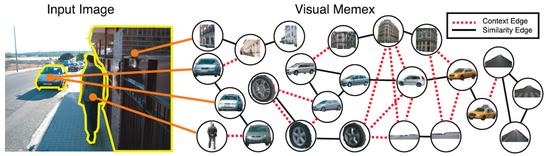
I present a model called the Visual Memex (visualized in Figure 2), which is a non-parametric graph-based model of visual concepts and their interactions. Unlike traditional approaches to object-object modeling which learn potentials between every pair of categories (the number of such pairs scales quadratically with the number of categories), I make no category assumptions for context.

The official paper is out, and can be found on my project page:

Tomasz Malisiewicz, Alexei A. Efros. Beyond Categories: The Visual Memex Model for Reasoning About Object Relationships. In NIPS, December 2009. PDF

Abstract: The use of context is critical for scene understanding in computer vision, where the recognition of an object is driven by both local appearance and the object's relationship to other elements of the scene (context). Most current approaches rely on modeling the relationships between object categories as a source of context. In this paper we seek to move beyond categories to provide a richer appearance-based model of context. We present an exemplar-based model of objects and their relationships, the Visual Memex, that encodes both local appearance and 2D spatial context between object instances. We evaluate our model on Torralba's proposed Context Challenge against a baseline category-based system. Our experiments suggest that moving beyond categories for context modeling appears to be quite beneficial, and may be the critical missing ingredient in scene understanding systems.

I gave at talk about my work yesterday at CMU's Misc-read and received some good feedback. I'll be at NIPS this December representing this body of research.