Tuesday, November 07, 2006

segmentation as inference in a graphical model

Recently, I've been playing with the idea of obtaining an image segmentation by inference on a random field. For a Probabilistic Graphical Models final class project, my teammate and I have been using Conditional Random Fields for segmentation. By posing segmentation as a superpixel labelling problem and placing a random field structure over the class posterior distribution, we were able to obtain cool looking segmentations.

On another note, did you know that logistic regression can be viewed as a conditional random field with one output variable? Once you see this, then you'll never forget why logistic regression looks the way it does. Maybe you should read this really cool CRF tutorial.

Wednesday, October 25, 2006

are you a frequentist? (Bayesianism vs Frequentism)

The answer is either a crisp yes (if you are one of those), or a fuzzy probably-not. As Carlos pointed out in Graphical Models class today, if you are a bayesianist then you would attribute a probability in (0,1) to you being a bayesianist.

On another note, I'm finishing up yet another excruciating Probabilistic Graphical Models homework. This time, we had to implement variable elimination for exact inference in bayesian networks. Additionally, we implemented the min-fill heuristic to find a good variable elimination ordering. The 37 node alarm network is depicted above (graphviz baby!). I wonder if my variable elimination code is good enough to work on 1000 node networks. Only one way to find out. :-)

On another note, I've been practicing Milonga del Angel by Astor Piazzolla on my classical guitar.

Wednesday, September 27, 2006

First half-lecture in front of a class

Yesterday I taught my first half-lecture for Martial's Computer Vision class. He was out of town, and we (the TAs) had to go over some new class material and go over the last/current homeworks. I think it went well.

Monday, September 18, 2006

textonify: texture classification with filters

A really good resource for vision researchers interested in texture-based classification is the Visual Geometry Group Texture Classification With Filters page.

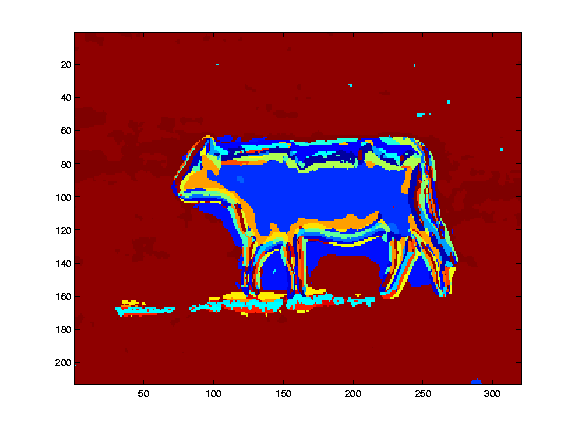
For your enjoyment, here is a textonmap image:

Saturday, September 02, 2006

Burton Clash 158

Today I purchased my first snowboard; a Burton Clash 158! I can't wait to try it out this winter season.

Friday, September 01, 2006

visual class recognition inside a bounding box


Let's consider the problem of determining the object class that is located inside a bounding box?

Consider the PASCAL 2006 Visual Object Classes:
{'bicycle' 'bus' 'car' 'cat' 'cow' 'dog' 'horse' 'motorbike' 'person' 'sheep'}

If we use boosted decision trees to train a classifier that returns a posterior distribution over visual object classes given the size of the bounding box as input, how well can we expect our classifier to perform?


Surprisingly, it ends up that for the PASCAL 2006 'trainval' dataset, if we train such a classifier we are able to get a test rate of 40% correct. Given no information we expect a 10% accuracy rate for 10 object classes( This is just like guessing randomly; you're correct 10% of the time), so 40% is decent given that the classifier didn't actually get any appearance features from the interior of the bounding box.

If we look at the separate visual classes and look at the boosted decision tree performance for that visual class, we see something rather interesting:

'bicycle' 0.2139
'bus' 0.0242
'car' 0.5973
'cat' 0.1714
'cow' 0.0314
'dog' 0.1381
'horse' 0.0760
'motorbike' 0.0375
'person' 0.8327
'sheep' 0.1472

This means that the bounding box dimensions are highly discriminative for
the person and car classes. 83% of the bounding boxes containing a person were given the correct label by the classifier! However, since people are generally standing it is not too surprising to realize that the height of a person bounding box is generally much larger than its width and generally in a similar ratio.

Saturday, August 19, 2006

Computer Vision TA + discovering music that I like

This upcoming semester I'll be one of the two Teaching Assistants for Martial Hebert's Computer Vision class. (The other TA will be Ankur Datta) Most Robotics PhD students take this graduate course to satisfy their perception requirement. Since the 1st semester of the 1st year is a very popular time to take this course (at least it was a popular time for my incoming class), this opportunity will give me a chance to meet the new Robograds.

On another note, I recently out about Pandora Internet Radio, which I have been listening to over the past few days. On this website, you input a favourite song or artist and a radio station is automatically created to match your interests in music. You can then vote for the songs that you heard. The basic idea is to get introduced to music you've never heard but you should enjoy. Another great source for internet radio is Shoutcast and archive.org (download live shows or just stream them!).